Research News › Archive › Press releases
Press release · Industry Collaboration Index 2026 · Australia and New Zealand edition
Global Research Partnerships
LONDON, United Kingdom, 15 October 2026
University of Queensland tops Australia in new global Industry Collaboration Index as five Australian universities make the world top 300
Melbourne, Sydney, UNSW and Monash follow Queensland, Auckland leads New Zealand and Newcastle with BHP is a Sector Award finalist, as Wageningen tops the world ahead of MIT.
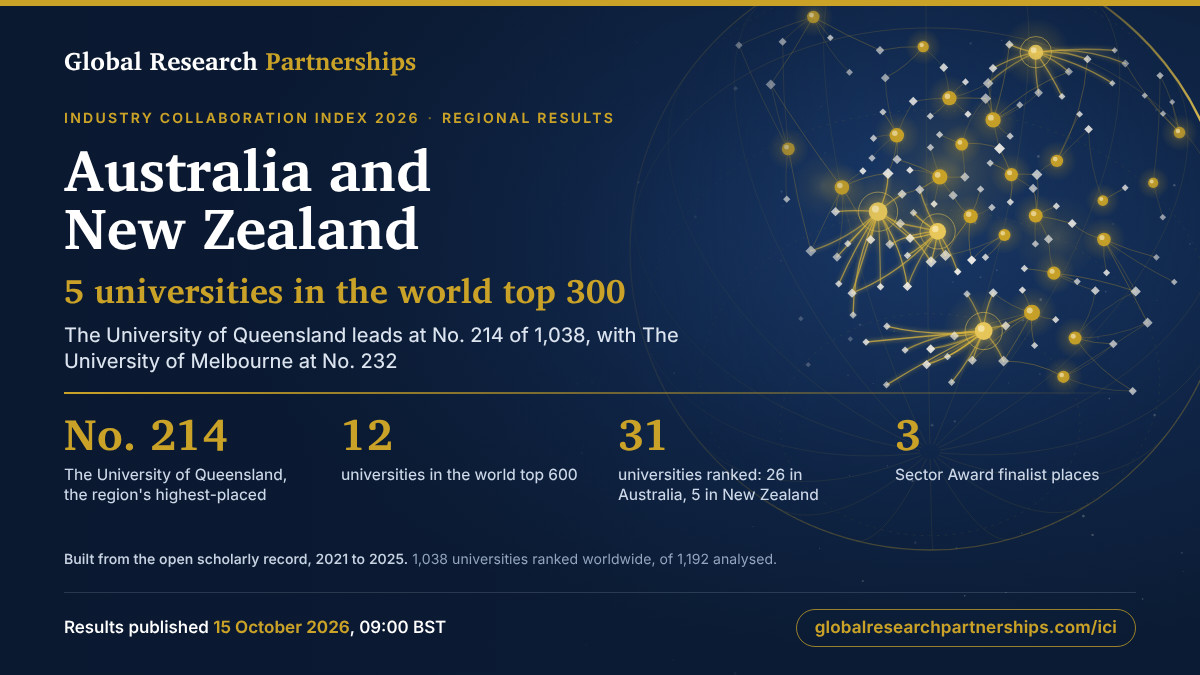
The University of Queensland leads Australia and New Zealand in the Industry Collaboration Index (ICI), a new global ranking of 1,038 universities on research co-written with companies, published today by Global Research Partnerships (GRP). Queensland is No. 214, ahead of Melbourne (No. 232), Sydney (No. 273), UNSW Sydney (No. 276) and Monash (No. 295): five Australian universities in the global top 300, all with Gold standing.
Worldwide, Wageningen University & Research, the Dutch food and agriculture university, has beaten MIT to No. 1, and Japan takes the next three places: Tokyo, Kyoto and Osaka.
Queensland's edge is breadth. Melbourne, Sydney and Monash all co-wrote more verified research with companies, but the 12 leading company partners of each work mainly in medicine. Queensland's partners span medicine (AstraZeneca and Pfizer), agriculture (Corteva) and engineering (Siemens), each working with it every year from 2021 to 2025.
Melbourne's total, over 2,500 works, is the region's largest and, like Monash's and Sydney's, among the 100 largest totals of the 1,192 universities analysed; Roche, Johnson & Johnson and the Australian biotechnology company CSL worked with it every year.
The same five stand far higher in GRP's Research Collaboration Index (RCI), which measures collaboration between universities: Monash is No. 7 of 1,195, Queensland No. 11, Melbourne No. 16, Sydney No. 19 and UNSW No. 31. In the ICI, their research with companies runs at 0.86 to 1.02 times what their mix of fields predicts, against 2.24 times for Wageningen: the two indices reveal different strengths.
Three of the region's partnerships, each active in all five years, are finalists in the 22 Sector Awards announced today, which go to the highest-scoring eligible partnership in each category with no panel, nomination or payment: the University of Newcastle with BHP (Chemicals, Process and Resources), Queensland with Corteva (Agriculture and Food Technology) and Sydney with Jingdong (Artificial Intelligence).
Australian industry runs through the results: BHP has worked with Adelaide, Rio Tinto with Western Australia and Curtin, and Cochlear with Macquarie, every year. In New Zealand, the University of Auckland leads at No. 505, working with Fonterra and Nestlé every year, ahead of Massey University (No. 635) and the University of Otago (No. 701); Massey also ranks 48 of 194 in Agriculture and Food Technology.
Most global rankings rest on reputation surveys, publications and citations, with collaboration at most a minor indicator. The ICI measures it directly through co-authored research, with no surveys or self-reported figures: from 2021 to 2025, the 1,192 universities analysed co-wrote 429,958 verified works with 40,786 company groups. For universities it is a benchmark; for companies, a map of which universities sustain partnerships in their field.
GRP checked 2,070,335 candidate university-company links against authors' affiliation text, confirming 1,148,566, and tested every overall position across 200 re-runs with the evidence resampled and the weights varied.
“Co-authored research is one visible, checkable trace of how universities and companies work together, and it deserves evidence as careful as any citation count. Every link in this index can be traced to what a researcher wrote about where they work,” said Daniel Llewellin of Global Research Partnerships.
The GRP Partnership Intelligence Platform, opening to partner universities on Monday 19 October, turns both indices and published funder records into next steps, from confirming peers and finding partners to matching live funding calls. It cannot change any position. GRP confirms availability and pricing with each university; onboarding takes three days. Early access: globalresearchpartnerships.com/platform/#first-access
Since the RCI launched on 15 September, universities from Sydney to Arizona have celebrated their results; the University of Sydney's newsroom reported its No. 19 place in the world.
Full results: globalresearchpartnerships.com/ici/
Australia: globalresearchpartnerships.com/ici/rankings/#country=AU
New Zealand: globalresearchpartnerships.com/ici/rankings/#country=NZ
Media enquiries: globalresearchpartnerships.com/ici/press/
ENDS
About Global Research Partnerships
Global Research Partnerships (GRP) publishes the Research Collaboration Index and the Industry Collaboration Index, two indices of equal standing built from the open scholarly record. The index is free, public and independent; no commercial relationship changes any position. globalresearchpartnerships.com
Media enquiries
Interviews, data and image requests: use the Industry Collaboration Index press and media page. Corrections and other requests about the index: the requests page.
Notes to editors
- Coverage: 1,192 universities in 81 countries and territories; research co-authored with companies in the open scholarly record, 2021 to 2025. The 1,038 with at least 100 verified industry works are ranked. Bands: Platinum 1 to 100, Gold 101 to 300, Silver 301 to 600, none beyond.
- Australia and New Zealand: 34 universities analysed (27 in Australia, 7 in New Zealand), 31 of them ranked (26 and 5). By band: 5 Gold (Queensland, Melbourne, Sydney, UNSW Sydney, Monash), 7 Silver (Western Australia, Adelaide, Macquarie, Auckland, Murdoch, Curtin, Australian National University) and 19 ranked beyond 600; three have too little verified evidence to be ranked. In the index both countries sit in its Asia-Pacific region; this release groups them together.
- Every sector position of 75 or better from the region, each out of that sector's own pool (none of these sectors is provisional):The University of Queensland 24 of 237 (Chemicals, Process and Resources), 45 of 194 (Agriculture and Food Technology) and 49 of 373 (Climate, Environment and Sustainability); The University of Melbourne 39 of 220 (Biotechnology and Advanced Therapies), 59 of 638 (Pharmaceuticals and Therapeutics) and 65 of 194 (Agriculture and Food Technology); Massey University 48 of 194 (Agriculture and Food Technology); The University of Sydney 51 of 220 (Biotechnology and Advanced Therapies), 51 of 323 (Medical Technology and Digital Health), 58 of 292 (Artificial Intelligence) and 72 of 638 (Pharmaceuticals and Therapeutics); UNSW Sydney 59 of 237 (Chemicals, Process and Resources) and 75 of 295 (Clean Energy Transition); The University of Western Australia 62 of 194 (Agriculture and Food Technology); Monash University 65 of 638 (Pharmaceuticals and Therapeutics); Curtin University 74 of 237 (Chemicals, Process and Resources).
- Sector Award finalists from the region: University of Newcastle Australia with BHP (Chemicals, Process and Resources); The University of Queensland with Corteva (Agriculture and Food Technology); The University of Sydney with Jingdong (Artificial Intelligence). Each pair co-published in all five years. The winners in those categories, announced with the index: Imperial College London with Shell (Chemicals, Process and Resources), Iowa State University with Bayer (Agriculture and Food Technology) and University of Oxford with Google (Artificial Intelligence). Live award pages list the winner first, then the other finalists alphabetically.
- Research with companies against what each university's mix of fields predicts (verified industry works divided by the number expected from its mix of fields, the basis of the co-creation pillar): The University of Melbourne 1.02 times, The University of Sydney 0.90, The University of Queensland 0.89, Monash University 0.88 and UNSW Sydney 0.86; for comparison, Wageningen University & Research 2.24 and MIT 1.81.
- Sectors: a university is ranked in a sector with at least 20 verified industry works in it; the sector score weights volume 30%, reach 25%, repeat partnerships (three or more works over two or more years) 25% and network influence within the sector 20%. Sectors with fewer than 50 eligible universities are provisional. The Robotics and Autonomous Systems ranking is withheld (9 eligible, below the minimum of 10); its Sector Award is still made.
- Pillars, each a percentile among ranked universities: co-creation 30% (the share of a university's research co-written with a verified company, against what its mix of fields predicts), durability 20% (the share of that work in sustained partnerships), scale 30% (the size of its industry network) and breadth 20% (how varied its company partners' main research fields are).
- Robustness: every published overall position is tested across 200 re-runs in which the works are resampled and each pillar weight varies by up to 25%.
- The winner in each category is the finalist with the highest partnership score (volume of joint work 40%, years active 30%, field-weighted citation impact 30%) in the frozen Edition 1 record. No panel, nomination or payment plays any part.
- The RCI and the ICI measure different things (collaboration between universities; co-authored research with companies) over different pools (1,195 universities in the RCI; 1,038 ranked in the ICI), so the two positions are printed side by side, never as a change from one to the other.
- Volume: "over 2,500 works" is the University of Melbourne's count of verified industry works, 2021 to 2025, in which a work shared through a dual affiliation counts half. "Among the 100 largest totals" places Melbourne, Monash and Sydney among the 100 universities with the most verified industry works of the 1,192 analysed; it is a count, not a position in the index.
- What the index does not measure: it shows co-authored research between universities and companies, not confidential projects, consultancy or licensing, and it does not show that jobs, products, therapies or economic outcomes resulted from any partnership. Clinical trials and funded partnerships are reported on university profiles, not scored.
- Industry and awards: market-producing state-owned enterprises count as industry, following the OECD Frascati Manual, and are marked throughout. Award eligibility is screened: partnerships with state-owned or state-controlled companies, with companies or universities on UK, EU, UN or US sanctions or restricted-party lists, or with companies that are primarily defence producers cannot win an award. The index itself counts every verified partnership.
- Reuse: the rankings, sector indices, award finalists, company verification table, topic-to-sector map and full link ledger are released under CC BY 4.0; attribute as “Industry Collaboration Index, Global Research Partnerships”. The RCI and the ICI have equal standing, and every university profile links to both.
- The University of Sydney's newsroom reported its RCI result (No. 19 in the world, Platinum standing) on 15 September 2026, in a story on its global ranking results; it is linked from the GRP homepage section on universities celebrating their results.
Explore the results
- ICI results
- ICI Australian results
- ICI New Zealand results
- ICI world rankings
- ICI regions
- ICI sectors
- ICI Sector Awards
- ICI methodology
- ICI press and media enquiries
- Intelligence Platform early access
- Research Collaboration Index (RCI)
- Both indices
Every edition of this release
The GRP Partnership Intelligence Platform
Your university beside the peers you choose, across both GRP indices: the universities and companies your peers work with that you do not, live funding calls matched to your strengths, the EU projects your peers have won, and a brief ready for your executive. It opens to partner universities on Monday 19 October 2026 and cannot change any position. GRP confirms availability and pricing with each university; onboarding takes three days.
Request early access →See what is inside →