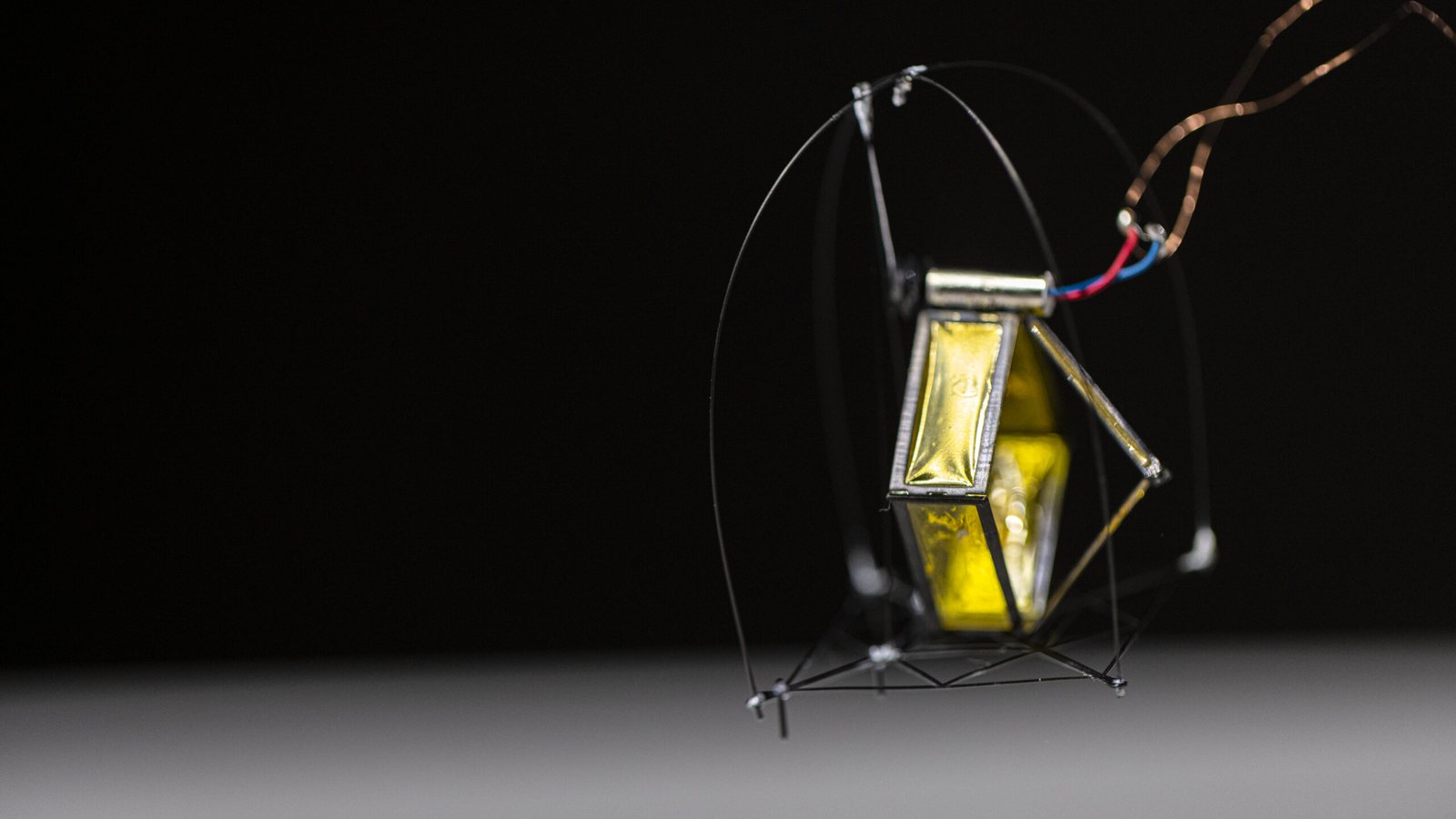
A one-gram robot that can choose exactly how high it jumps
University of Washington engineers have built DirectHop, a motor-driven hopping robot that jumps to a set height within a centimetre, rights itself and hops again.
Engineers at the University of Washington have built DirectHop, a robot weighing roughly one gram that can hop repeatedly and jump high enough to clear a standard stair step. Using a tiny electric motor and three folding legs, it launches itself to a specified height with single-centimetre accuracy. After landing it can twitch to right itself and prepare for another jump, addressing several long-standing challenges for hopping robots.
Most hopping robots copy spring-loaded insects such as fleas, which makes jump distance hard to control. DirectHop drops the spring: its motor, attached to a tower by fishing line, spools the line quickly and pulls the robot into the air, while hinged legs keep it aligned. Adjusting the motor current sets the jump height. A roll cage inspired by box turtles lets the team right the robot 90 per cent of the time.
Lead author Hanquan (John) Wang, a graduate research assistant in mechanical engineering, worked with senior author Sawyer Fuller, associate professor of mechanical engineering, and co-author Yash Talwekar. The team will present the work at the International Conference on Intelligent Robots and Systems. "We found that a very small electric motor can accelerate fast enough to power a jump directly, the way a frog's leg muscles directly power its hop," said Wang.
Hopping is nearly two orders of magnitude more energy efficient than flying, so groups of small hopping robots could explore places more cheaply than drones, from finding gas leaks in refineries to monitoring farms or even other planets. The prototype still relies on wired power, but the team is working on solar cells, steering and onboard cameras, and Wang estimates a fully featured robot could cost about 10 US dollars.
Source: the original release from University of Washington. Summarised by GRP Research News.
For universities
The GRP Partnership Intelligence Platform
Your university beside the peers you choose, across both GRP indices: the universities and companies your peers work with that you do not, live funding calls matched to your strengths, the EU projects your peers have won, and a brief ready for your executive. A partner service now onboarding founding partner universities: enquire, and the GRP team will confirm availability and pricing for your university.