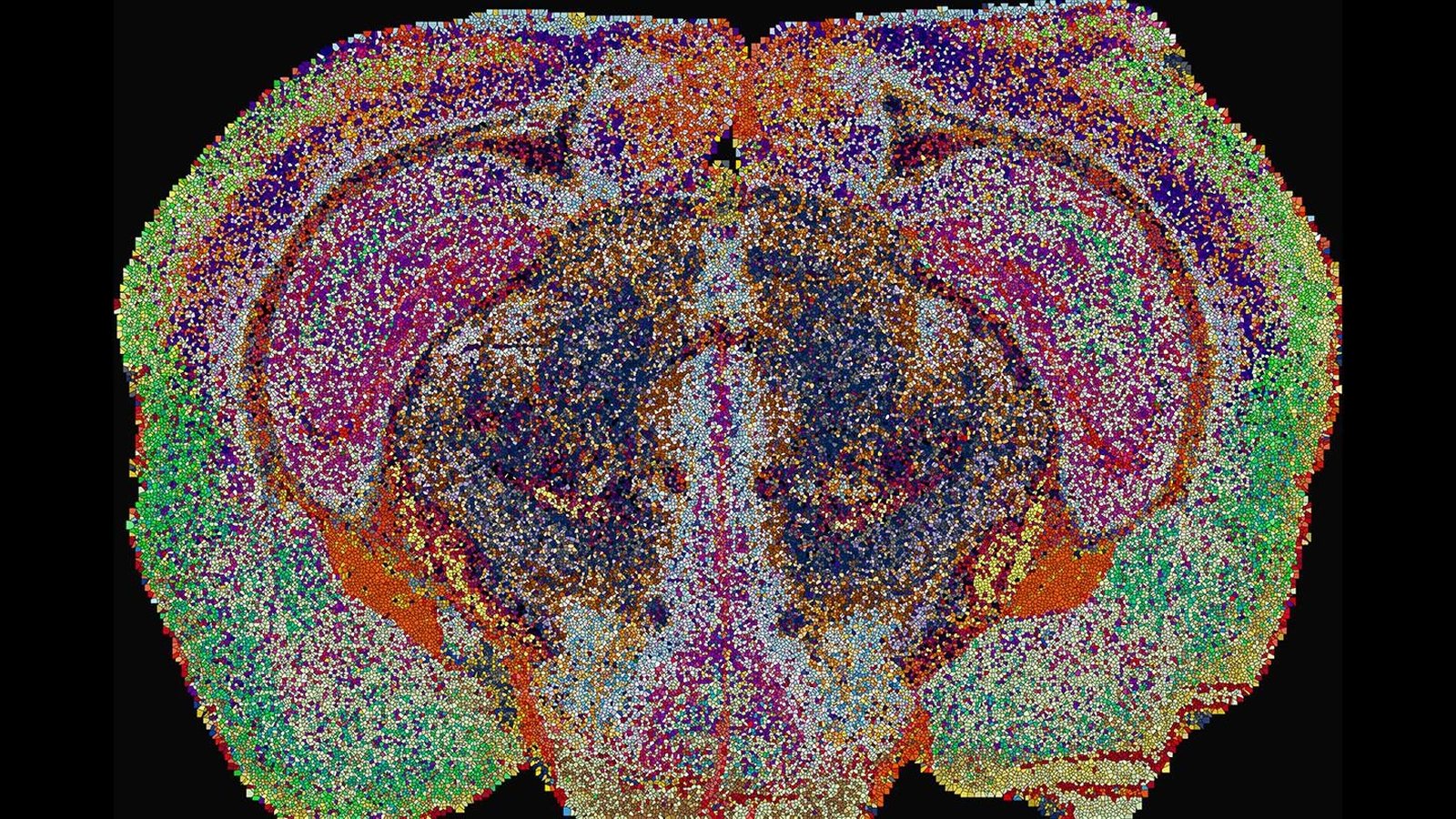
EPFL atlas charts the fats of the mouse brain and finds 539 chemical zones
The Lipid Brain Atlas maps 172 lipids across the whole mouse brain, revealing an orderly chemical layout that is redrawn during pregnancy.
Much of the brain is made of lipids, the fatty molecules that form nerve cell membranes, wrap nerve fibres in myelin and help cells signal. Yet unlike genes and proteins, they have been hard to map because standard imaging struggles to tell them apart. A team at EPFL has now built the first detailed atlas of lipids across the entire mouse brain, published in Nature.
The researchers used mass spectrometry imaging, firing a laser point by point across thin brain slices to record where each lipid sits. They measured 172 lipids in 109 slices from 11 mice, and custom machine-learning tools turned about 7 million readings into a 3D model. The map divides the brain into 539 territories, called lipizones, each with its own lipid signature.
The work was led by Giovanni D'Angelo, Luca Fusar Bassini and Gioele La Manno. The atlas follows known brain anatomy but also reveals chemical borders not seen before, including in the choroid plexus. "In effect, lipids work like postal codes, giving distant but related parts of the brain the same chemical address," D'Angelo said.
The atlas also showed that pregnancy reshapes the brain's lipid map, with shifts larger than typical differences between males and females, heavy changes in the cortex and a sharp rise in galactosyl ceramide across much of the white matter. Because changes in brain lipids are increasingly linked to conditions from depression to Alzheimer's disease, the team sees the method as something that could carry over to human research.
Source: the original release from EPFL, reporting research published in Nature. Summarised by GRP Research News.
For universities
The GRP Partnership Intelligence Platform
Your university beside the peers you choose, across both GRP indices: the universities and companies your peers work with that you do not, live funding calls matched to your strengths, the EU projects your peers have won, and a brief ready for your executive. A partner service now onboarding founding partner universities: enquire, and the GRP team will confirm availability and pricing for your university.