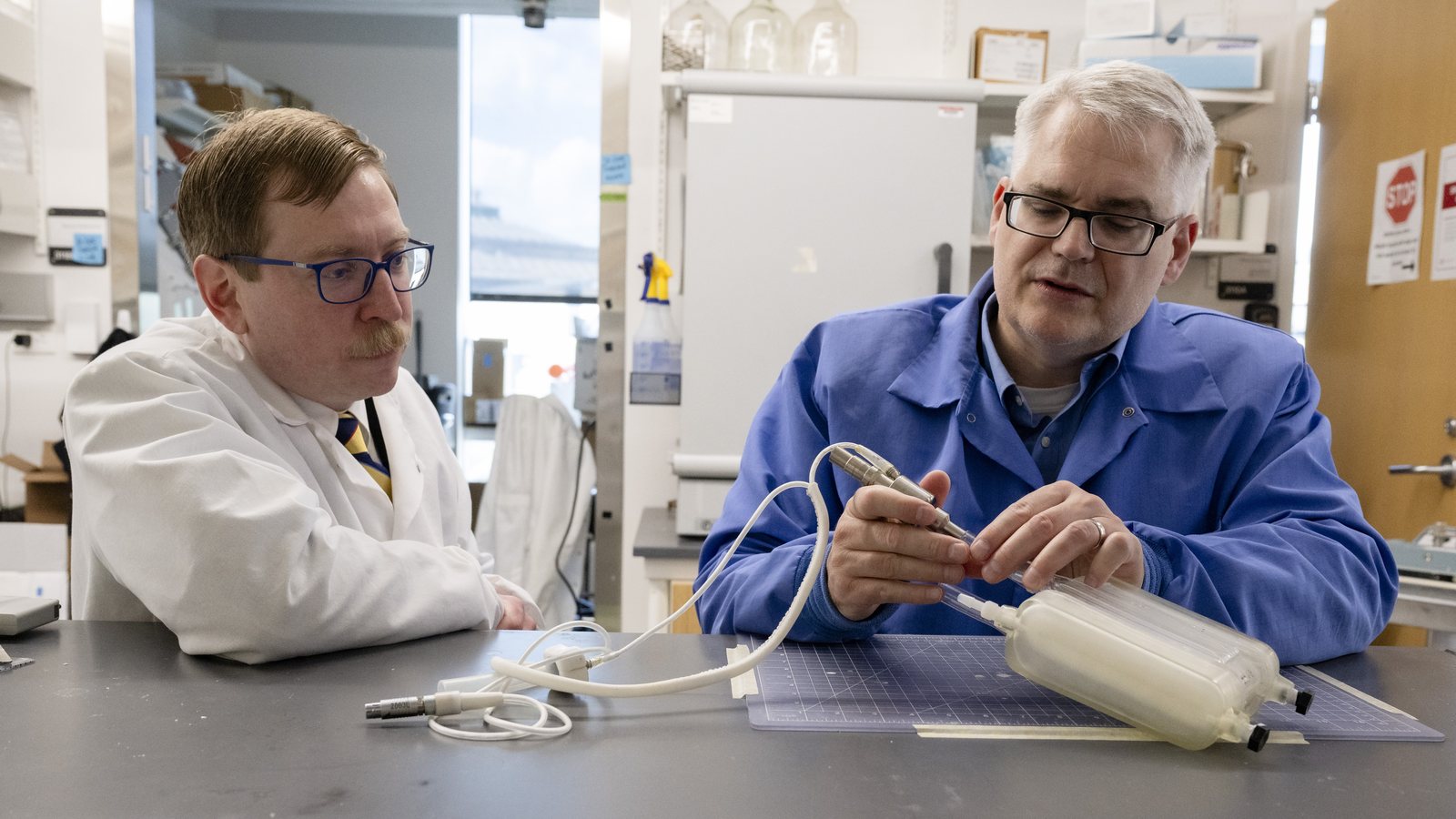
A portable artificial lung aims to offer an alternative to ventilators and transplants
Carnegie Mellon researchers and their spinout, Advanced Respiratory Technologies, have built a compact device that oxygenates blood outside the body while patients stay awake and mobile.
Researchers at Carnegie Mellon University have developed an artificial lung that could give people with chronic lung disease a long-term treatment option. The device, built by the university spinout Advanced Respiratory Technologies (ART), could be in hospital use within a few years. The project is led by Keith Cook, head of the Department of Biomedical Engineering, and David Skoog, ART's chief scientific officer, who completed his PhD at Carnegie Mellon.
Rather than pumping air into the lungs as a ventilator does, the system circulates the blood itself. Tubes inserted in the neck or chest carry blood to an external unit that removes carbon dioxide and adds oxygen before returning it to the body. Patients can remain fully awake, eat on their own and move independently, avoiding the lung damage that the team says long-term mechanical ventilation causes.
A central obstacle was blood's tendency to clot on contact with foreign materials. The team made the device as compact as possible to reduce the surface blood touches, and coated it with a bioengineered material that blood reacts to much as it does to water. “We don't think there's a silver bullet, but we do think that if you layer multiple technologies on top of each other, there will be an outsized positive effect,” Cook said.
The work has received $24 million in past federal support from the US Department of Defense, DARPA and the National Institutes of Health, reflecting its potential for veterans and wounded soldiers. The device still needs clearance from the US Food and Drug Administration, and the team aims to bring it into hospitals within 18 to 24 months through the 510(k) pathway.
Source: the original release from Carnegie Mellon University. Summarised by GRP Research News.
For universities
The GRP Partnership Intelligence Platform
Your university beside the peers you choose, across both GRP indices: the universities and companies your peers work with that you do not, live funding calls matched to your strengths, the EU projects your peers have won, and a brief ready for your executive. A partner service now onboarding founding partner universities: enquire, and the GRP team will confirm availability and pricing for your university.